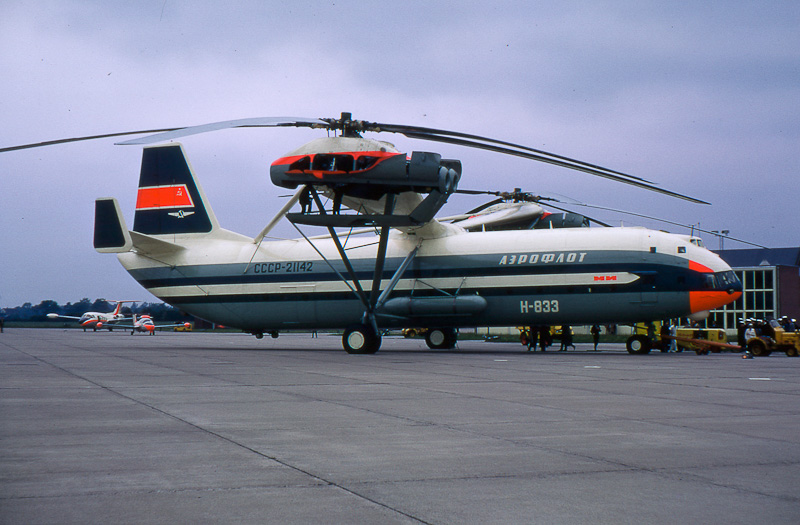
The Mil Mi12 is a 120-seat heavy transport helicopter powered by four Soloviev
D-25VF turboshaft engines. The Mil Mi-12 (NATO reporting name 'Homer') project started in the Soviet Union in 1965.
The prototype Mil V-12 flew first in 1968. This giant helicopter had fixed wings and was lifted by two Mi-6 rotors mounted at the ends
of outrigger wings. Both rotors were driven by two 6500shp Soloviev D-25VF turbine engines each, mounted
side-by-side at the tips of the wings. The four 6500shp Soloviev D-25VF turbines giving the Mil V-12 a maximum speed of 260km/h,
with a 35400kg load or 120 passengers and 500km range. Two V12 prototypes were built. Both prototypes had the same registration!
This registration CCCP-21142 is in Cyrillic and means SSSR-21142.
The first prototype was damaged in a heavy landing, but was repaired.
The rebuilt first prototype Mil V-12 is located today next to the Mil Helicopter factory in Lyubertsi-Panki. The second prototype Mil V-12 CCCP-21142 is at
the Central Museum of the Air Forces at Monino, located approximately 38 km from Moscow, Russia. The Mil Mi-12 never entered production.
On 24 May 1971, the arrival of the first prototype of the Mil Mi-12 at
Groningen Airport Eelde (EHGG/GRQ) in the Netherlands was a sensation. This
helicopter is the largest helicopter of the world. Mil Mi-8V CCCP-11097
escorted Mil V-12 CCCP-21142. Both helicopters were on their way to the Paris Air Show
(Salon International de l'Aéronautique et de l'Espace) at Paris-Le Bourget, France, and came in at Eelde for re-fueling.
The first prototype Mil V-12 flew first in 1968. The second prototype did not
leave the factory in Panki until late 1973. In 1974, the whole program
was stopped and both Mil V-12s went on display. The photographs of
Mil V-12 CCCP-21142 on the cover of the Airlife publication "Vintage Russian" have been placed without permission
and acknowledgment of the source but have been taken by Jack Wolbrink during the time the CCCP-21142 staid at Eelde. Although
this is known to the publisher of Airlife, no action has been taken by the publisher to protect the copyrights.